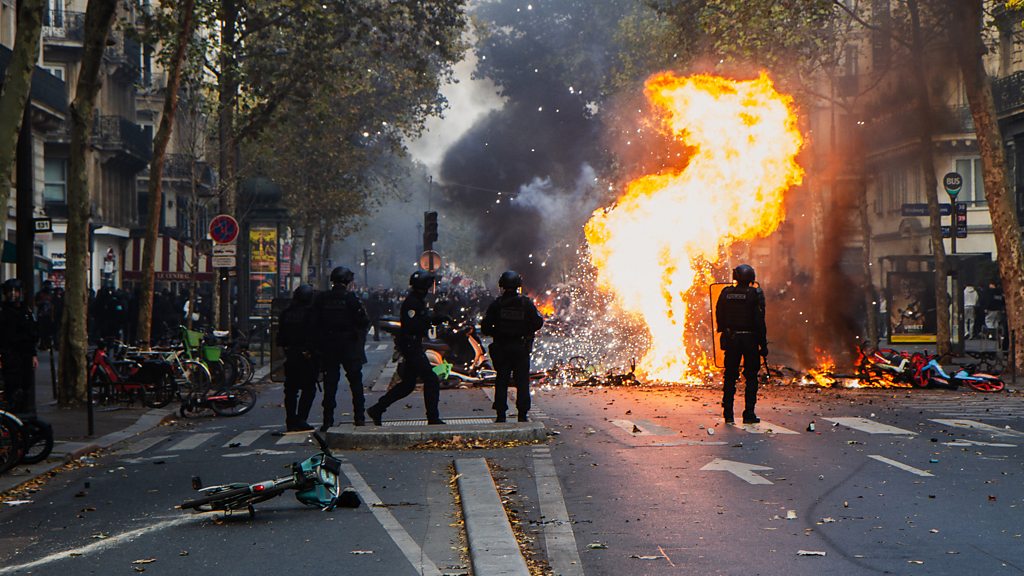
The measures mark a sharp escalation in the French authorities’ response to unrest that followed serious disturbances and violence. Handelsblatt reported that Macron had adopted a hard line on applications to hold demonstrations, while BBC Business described the wider crisis as involving mass protests, violence and opposition to economic reform.
Under the reported policy, demonstrations organized by trade unions would be authorized, while other gatherings could face restrictions or prohibition. The available accounts differ on the policy’s precise reach: Clarín described arrangements for the reported Saturday mobilization under which union demonstrations could use alternative routes, while non-union demonstrations would be prohibited where possible.
The approach places the organization of a protest at the center of the authorities’ decision-making. The reported arrangements also seek to keep authorized marches away from commercial areas and public buildings, according to Clarín’s account of Macron’s remarks. The supplied reporting does not establish the complete legal framework behind the restrictions or how long they are intended to remain in force.
Macron also convened a defense council to consider additional measures. Clarín reported that the council was due to meet the following morning and that Macron said further decisions would be taken after a meeting with intelligence services. EL PAÍS likewise reported the council as part of the government’s response to the planned weekend mobilizations.
EL PAÍS reported that Macron accused organized ultra-left groups of acts or intentions that he characterized as a serious threat to the republic. Clarín similarly reported that he described such groups as highly dangerous and associated them with extreme violence and prior planning. Those accounts establish Macron’s allegation, not the independent truth of the accusation.
A large Yellow Vest mobilization was expected for the upcoming Saturday, according to Clarín. The report described the march as a protest against the rising cost of living and said it was to take place amid wider political, social and security tensions. The supplied sources do not establish the exact scale of the planned demonstrations.
Clarín also reported that police and military personnel from the Sentinelle counterterrorism operation would participate in security arrangements for the planned march. The same account said the government had not ruled out calling on the armed forces if violence escalated and threatened general security. That is different from establishing that the army had already been mobilized.
The policy therefore combines tighter control over which demonstrations may proceed with additional security planning and political consultations. The evidence supports a government response to recent violence and anticipated mobilization, but it does not establish the eventual duration of the restrictions, their full legal scope or how authorities will apply them beyond the reported arrangements.
SOURCES
- ClarínFrancia se blinda ante el anuncio de nuevas marchas y Emmanuel Macron moviliza al ejército
- EL PAÍSFrancia solo autorizará las manifestaciones convocadas por los sindicatos para prevenir nuevos disturbios
- HandelsblattKrise in Frankreich: Macron vor neuen Protesten: Nur Gewerkschafts-Demos erlaubt
- BBC BusinessThe Briefing Room