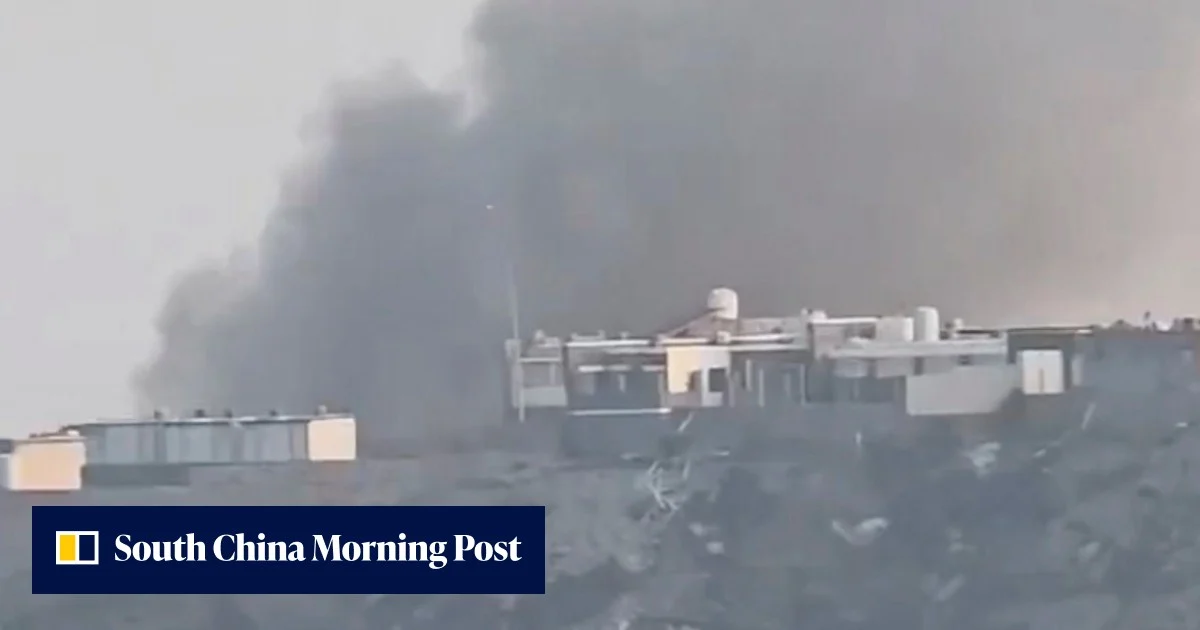
A strike at the government’s interim seat
The reported attack placed Aden’s presidential palace at the center of a significant escalation between the Houthis and the Saudi-backed government. Three supplied reports — from South China Morning Post, Al Jazeera and Bloomberg Markets — described Houthi missiles being launched at or striking the presidential palace. The palace is not simply a symbolic site in the available coverage: it is described as the interim seat, headquarters or seat of power of Yemen’s internationally recognized government. That status gives the incident a direct institutional dimension, even though the evidence does not resolve the precise point where the missiles landed or whether the building itself sustained a direct hit.
Al Jazeera reported that five people were killed and 16 others injured, citing Yemen’s health minister. The figures are not independently confirmed in the supplied material, so they should be understood as a statement attributed to the minister rather than as an independently verified casualty count. South China Morning Post and Al Jazeera both characterized the attack as deadly, establishing that deaths were reported even though the wider evidence does not provide an independently verified total. The available sources also do not give a confirmed account of the damage to the palace, nearby buildings or other sites in the vicinity.
Conflicting accounts of the target
Yemeni Information Minister Moammar al-Eryani said the Houthis had targeted the al-Maashiq presidential palace with five missiles, according to Al Jazeera. The report also said smoke was seen rising from the vicinity of the palace and that explosions were reported near it. Those details support the description of an attack in the palace area, but they do not by themselves establish that the palace was the missile impact point. The distinction matters because the available accounts describe the attack in different ways: some identify the palace as the target, while another account preserves a different explanation from the Houthis.
Deutsche Welle reported that the Houthis said they were targeting Saudi military assets rather than necessarily the palace itself. That claim leaves open the possibility that military positions near the government complex were the intended objective. It does not overturn the broader, multi-source account that missiles were launched or targeted at the presidential palace area in Aden. Instead, it exposes the central unresolved question in the incident: whether the palace was the intended target, whether it was struck directly, or whether the attack was aimed at nearby Saudi-linked military assets. The supplied material does not provide enough evidence to choose among those possibilities.
The uncertainty is also reflected in the language used by the reporting. Deutsche Welle described the incident as a rare attack on the interim seat of the internationally recognized government. An Al Jazeera correspondent characterized attacks on the headquarters of that government as the first of their kind by the Houthis. Those descriptions are attributed assessments from the respective coverage, not an independently measured historical conclusion supplied by the evidence. They nevertheless indicate why the incident was treated as more than another exchange of fire: the reported target was the location from which the internationally recognized government operates.
Government officials and reported casualties
The Yemeni government said the prime minister and other officials were safe after the attack, while two bodyguards were killed, Al Jazeera reported. The safety statement and the account of the bodyguards are therefore government claims carried by that outlet, not independently verified findings in the supplied material. They offer a limited picture of the immediate human impact: senior officials were reported safe, while deaths occurred among people connected to the protection of the government site. The same report, citing Yemen’s health minister, gave the broader toll as five dead and 16 injured. No separate source in the supplied evidence confirms those figures.
The reported casualty figures should also be separated from the confirmed characterization that the attack was deadly. The latter is supported by South China Morning Post and Al Jazeera, while the exact numbers come from a single attributed account. This difference is important in assessing what can be stated firmly. It is established that the missile attack caused deaths; it is not independently established from the supplied material how many people were killed or injured, nor how extensive the physical damage was. The evidence similarly does not establish whether all reported casualties were inside the palace, near it, or elsewhere in the surrounding area.
Regional accusations around the attack
The incident was reported alongside competing claims about the wider military confrontation. The Saudi-led coalition accused the Houthis of obtaining missile parts or ballistic missiles from other regional states, according to Al Jazeera. That is an accusation by the coalition and its spokesperson, not an independently established finding in the supplied material. Saudi Arabia also blamed Iran for the broader recent escalation involving the Houthis, South China Morning Post reported. The supplied evidence does not confirm that Iran directed or materially supported this specific attack, so the Saudi allegation must remain explicitly attributed.
South China Morning Post and Bloomberg Markets described the Houthis in their coverage as Iran-backed. That characterization provides context for why Iran featured in Saudi statements about the escalation, but it does not establish a chain of command for the Aden operation or prove that Iranian assistance was involved in it. The distinction is especially important because the evidence contains several different propositions: a description of the Houthis as Iran-backed, a Saudi accusation about Iran’s role in a broader escalation, and a coalition allegation about missile supplies from regional states. None of those claims independently settles what happened in the palace area.
What the evidence establishes
Taken together, the supplied reporting establishes a missile attack by Houthi forces directed at or involving Yemen’s presidential palace in Aden on October 15. It establishes that the site serves as the interim seat or headquarters of the internationally recognized, Saudi-backed government and that the attack was deadly. It also records the Yemeni government’s account of five missiles, the reported safety of the prime minister and other officials, and the reported deaths of two bodyguards. Those details remain attributed to Yemeni officials where the evidence identifies them as such. The sources agree on the core event while differing over the intended target and the extent to which the palace itself was struck.
The incident’s significance therefore rests on both its location and its unresolved details. A missile attack involving the interim seat of the internationally recognized government was described by Deutsche Welle as rare, while Al Jazeera’s correspondent described such attacks as unprecedented in the supplied coverage. At the same time, the evidence does not support a definitive statement about the palace’s impact point, the full extent of damage, or Iran’s role in this specific operation. The strongest evidence-bounded account is consequently one that reports the attack directly, preserves the competing descriptions of its target, and treats casualty, supply and regional-involvement claims according to their stated attribution.