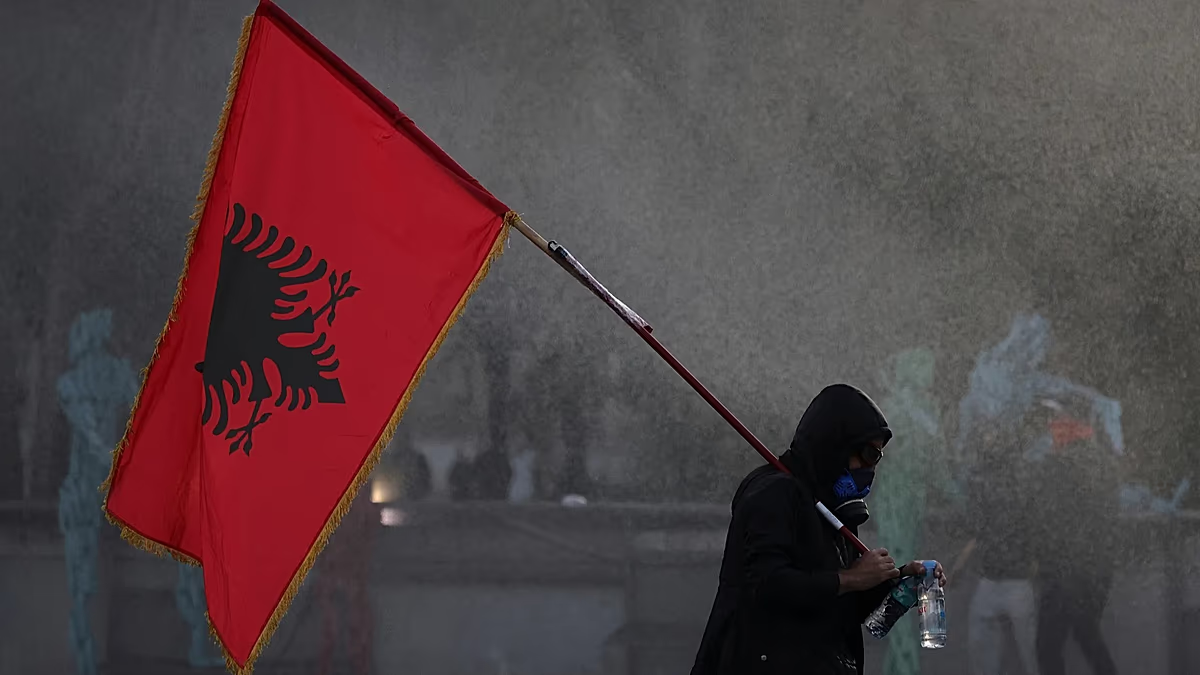
A fourth day of protests in Tirana The demonstrations began on Tuesday and continued through Friday, 16 October, according to the three reports examined for this article. Thousands of young protesters gathered in Albania’s capital, where the central political demand was Rama’s resignation. The protests were described as student-led, although the reported grievances extended beyond university issues to wider criticism of the government. The mobilisation therefore combined a call for a change in national leadership with demands focused on education and public life. The exact size of the crowds was not specified beyond the description of thousands, and the reports did not provide a consolidated account of injuries or property damage.
The confrontation became particularly visible outside Albania’s education ministry. Al Jazeera and Euronews reported that riot police clashed with protesters there for a fourth day. Demonstrators threw rocks, while police used tear gas and water cannon. The accounts describe a cycle in which a protest centred on political and educational demands became a street confrontation involving riot-control measures. They do not establish how many people were injured in those clashes, nor do they offer a complete independent assessment of damage caused during the unrest.
Police said that 160 people were detained after violent incidents on Thursday evening, a figure reported by Euronews and Al Jazeera. That number is a police-reported total, rather than an independently verified count of people ultimately charged or held. The reports also describe demonstrators throwing stones and police responding with tear gas and water cannon. The available reporting does not establish that every person detained took part in violence, and it does not provide a breakdown of the circumstances of the detentions.
The grievances behind the mobilisation The reported complaints were not limited to a single policy. They included government corruption, poor university conditions, education reform and high tuition fees. France 24 highlighted university conditions and tuition costs, while Al Jazeera reported concerns about corruption and the state of universities. Euronews described protesters as seeking education reforms. These accounts identify the issues raised in the demonstrations, but they do not show that every protester supported every demand or that the movement had a single agreed programme beyond the demand for Rama to resign.
Students also boycotted classes as the unrest spread, according to the reporting. The movement was thus visible both in public demonstrations and in opposition to normal university activity. The sources portray the education system as an important point of mobilisation, while also connecting the protests to broader anger over government conduct. That combination helps explain why the demonstrations were described both as student protests and as anti-government unrest. The reporting does not quantify the number of students taking part in the boycott or indicate whether the action involved all universities.
The protests were not confined to the capital. Euronews and Al Jazeera reported that demonstrations spread to other Albanian cities, including Elbasan, Shkodra and Korca. In those locations, the reports referred to broken windows and rubbish bins being set on fire. The spread beyond Tirana indicates a wider geographic reach than the capital-centred clashes, but the sources do not give crowd figures for the individual cities. They also do not establish whether the same combination of education, corruption and political demands was present at each local demonstration.
Rama’s foreign-interference allegation Rama responded by blaming what he called “foreign hands” for the unrest and saying they did not want Albania to be at peace. His remarks were reported by Euronews, France 24 and Al Jazeera. In a separate account, Al Jazeera reported that Rama rejected the idea that the protests reflected the hardships or legitimate aspirations of people seeking a better life. The allegation is a statement by the prime minister, not an independently established explanation for the protests. The supplied reports do not identify the alleged actors or provide independent evidence substantiating his claim.
France 24 reported that Rama said the alleged foreign involvement was intended to hinder Albania’s bid to join the European Union. That specific motive appears in the France 24 account and is therefore attributed to that report rather than presented as an independently verified finding. Euronews also reported that the European Union delegation in Albania expressed concern about the violent escalation and called for a proportionate response from authorities. The delegation’s reported position addresses the response to the unrest; it does not confirm Rama’s allegation about foreign involvement.
The European Union dimension The EU has entered the story in two distinct ways in the reporting. First, Rama’s remarks connected the alleged foreign role to Albania’s effort to join the bloc, according to France 24. Second, the EU delegation in Albania was reported by Euronews as calling for authorities to respond proportionately and expressing concern about the violence in Tirana. Neither report establishes that the European Union endorsed the protesters’ demands. Nor does the reported EU statement resolve the dispute between Rama’s interpretation of the unrest and protesters’ stated focus on corruption, education and his resignation.
The immediate political dispute is therefore being framed in sharply different terms. Protesters have demanded Rama’s resignation and raised education and corruption-related grievances, while Rama has described the unrest as driven by unnamed outside forces. The reporting confirms that both the demonstrations and the clashes occurred, and that police reported 160 detentions after Thursday’s violence. It does not establish whether the foreign-interference allegation is true, identify the alleged actors, or show that the accusation explains the breadth of the protests.