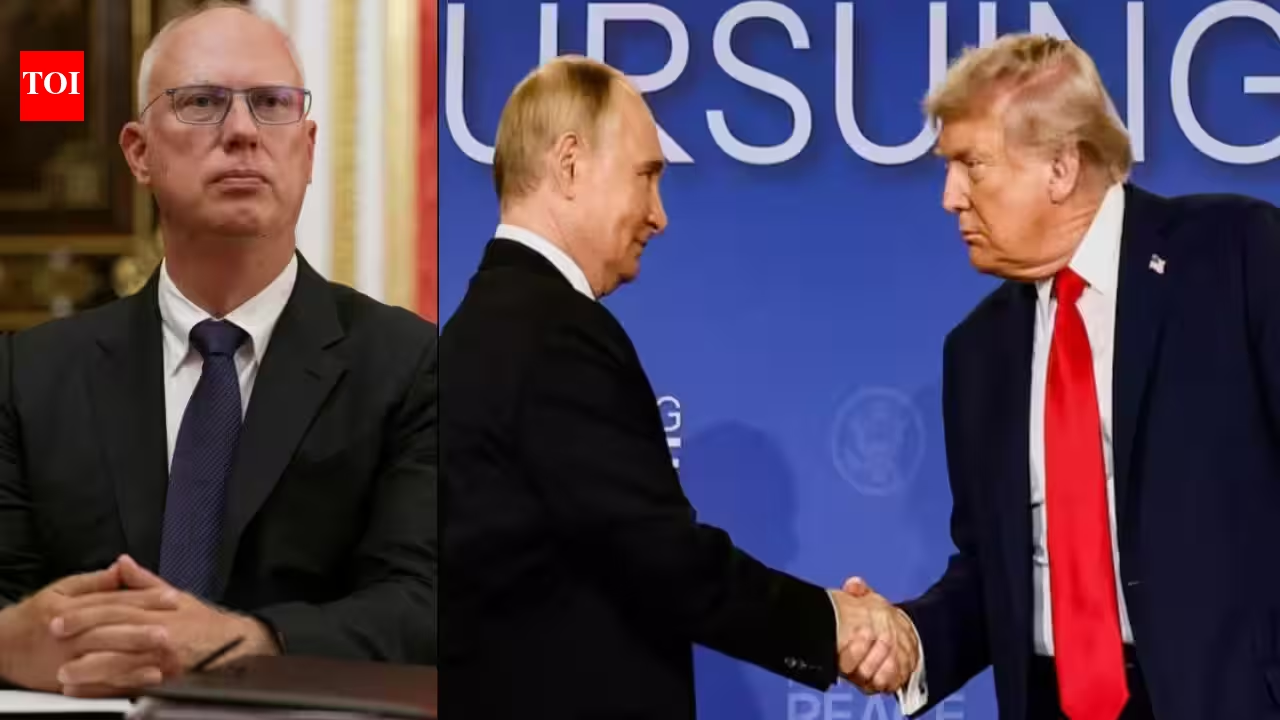
The executive action and its stated basis
The order suspends or places on hold key parts of a sanctions package directed at Russia, along with related tariff provisions. The supplied reporting differs over the precise legal effect: some accounts describe the measures as blocked or left without effect, while others describe a waiver covering certain provisions. Those accounts agree on the central development: Trump used an executive order to pause the package rather than allowing the full set of measures to proceed. The White House’s stated justification was the national interest of the United States. The available material does not provide a further explanation of what considerations were included in that assessment.
The package was associated with the Lindsey O. Graham Sanctioning Russia and Iran Act of 2026, named after the late South Carolina senator Lindsey Graham. The legislation had been backed by Graham and Democratic Senator Richard Blumenthal, according to the supplied reporting, and was designed to increase pressure on Moscow over its invasion or war in Ukraine. Its stated target was not limited to one part of the Russian economy: the measure was intended to affect officials, financial institutions, the defense sector and resources connected with Russia’s war effort. Trump’s decision therefore pauses a framework that had been presented as a broad instrument of economic pressure rather than a narrow restriction on a single transaction.
What the legislation would have covered
The available descriptions say the legislation authorized or contemplated sanctions against Russian officials and banks, as well as vessels associated with the country’s oil-shipping shadow fleet. The package also included tariffs of up to 100 percent on major buyers of Russian oil and gas. Those provisions would have extended the measure beyond direct restrictions on Russian entities by potentially affecting countries and companies that continued purchasing Russian energy or helped Moscow evade sanctions. The supplied sources do not establish that every measure would have taken effect in the same way or at the same time, and they differ in how broadly they describe the executive order’s waiver. The common point is that the order interrupted implementation of important parts of the package.
The sanctions framework had been presented as a response to Russia’s invasion of Ukraine and as a way to restrict financial resources supporting the war. In the reporting supplied for this article, the package is described as targeting both Russia’s domestic economic institutions and parts of the energy trade that can provide revenue or access to international markets. The proposed tariffs on major buyers would also have carried consequences beyond the United States and Russia because they were aimed at countries continuing to purchase Russian oil and gas. The evidence does not establish the package’s eventual economic impact, because the executive order placed key provisions on hold.
Diesel agreement changes the immediate context
The suspension followed a reported agreement for Moscow to supply diesel to the global and U.S. markets. That link is documented in the supplied reporting, but the evidence does not specify the agreement’s volume, duration, legal terms or implementation. It therefore cannot establish how much fuel would be delivered, when deliveries would begin, or whether the arrangement would produce a measurable change in prices. The timing nevertheless places energy supply at the center of the decision’s immediate context. The order paused measures that could have affected Russian energy interests after the reported diesel agreement brought U.S.-Russia commercial dealings into focus.
Some reporting, including Clarín’s account, linked the diesel and sanctions decisions to concerns about fuel prices and the approaching U.S. midterm elections. That connection remains reported context rather than an independently established administration motive. The White House statement cited in the supplied material refers to the U.S. national interest but gives no further detail. It does not, on the evidence available here, confirm that electoral considerations or a particular fuel-price objective drove the decision. The distinction matters because the reported commercial agreement and the stated official justification are documented, while the political interpretation is attributed to coverage rather than directly established.
Moscow welcomes the pause
Kirill Dmitriev, identified by the supplied sources as Putin’s investment envoy or representative, praised the suspension as an important and truly historic moment. His response reflects the Russian side’s assessment of the decision, not an independent finding about its economic or diplomatic consequences. The reporting says Dmitriev argued that the legislation could have seriously harmed the U.S. economy and global markets and that economic cooperation between Russia and the United States served both countries. Those comments were presented as his view of the proposed sanctions and of the value of cooperation. They do not alter the White House’s narrower stated explanation that the waiver was in the U.S. national interest.
The decision also places the administration’s sanctions policy alongside a reported effort to maintain or expand an energy-related channel with Moscow. The evidence supports describing these developments as connected in timing and reporting, but it does not establish a broader policy settlement between Washington and Moscow. Nor does it establish that the diesel arrangement resolved disputes involving Russia’s war in Ukraine or the wider sanctions regime. The sources identify a pause in important provisions, not a documented permanent withdrawal of the legislation. That distinction leaves open whether the suspended measures could later be applied or changed.
What remains unresolved
The supplied reporting does not provide an exact end date for the suspension. One account says the pause remains in effect until Trump or senior U.S. officials determine that further action is appropriate. The evidence therefore supports describing the action as temporary or subject to later determination, rather than as a permanent repeal or withdrawal of the sanctions legislation. It also does not establish whether all provisions were affected equally, how the tariffs would interact with the sanctions measures, or whether any part of the package remained operative. Those legal and procedural details are important but cannot be resolved from the supplied material.
The reported diesel agreement presents a similar limitation. The sources establish an arrangement for Moscow to supply diesel to the U.S. and global markets, but they do not give its volume, duration, legal structure or implementation details. As a result, the evidence does not support a conclusion about the agreement’s effect on American fuel prices, Russia’s revenues or the broader energy market. Likewise, the available material does not establish whether the suspension changed relations with Ukraine or European states beyond the potential implications of delaying the sanctions package. Those consequences remain matters for later evidence, not conclusions supported by the current record.
For now, the confirmed change is narrower but consequential: Trump has paused key provisions of a sanctions and tariff framework designed to intensify pressure on Russia over its war in Ukraine. The White House has identified the national interest as the basis for the suspension, while a representative of Putin has welcomed it as historic. The reported diesel arrangement supplies the immediate context, but its terms and results remain unspecified. The duration, legal scope and eventual fate of the suspended measures are also unresolved, leaving the executive order as a pause whose longer-term significance depends on subsequent decisions by the U.S. president or senior officials.