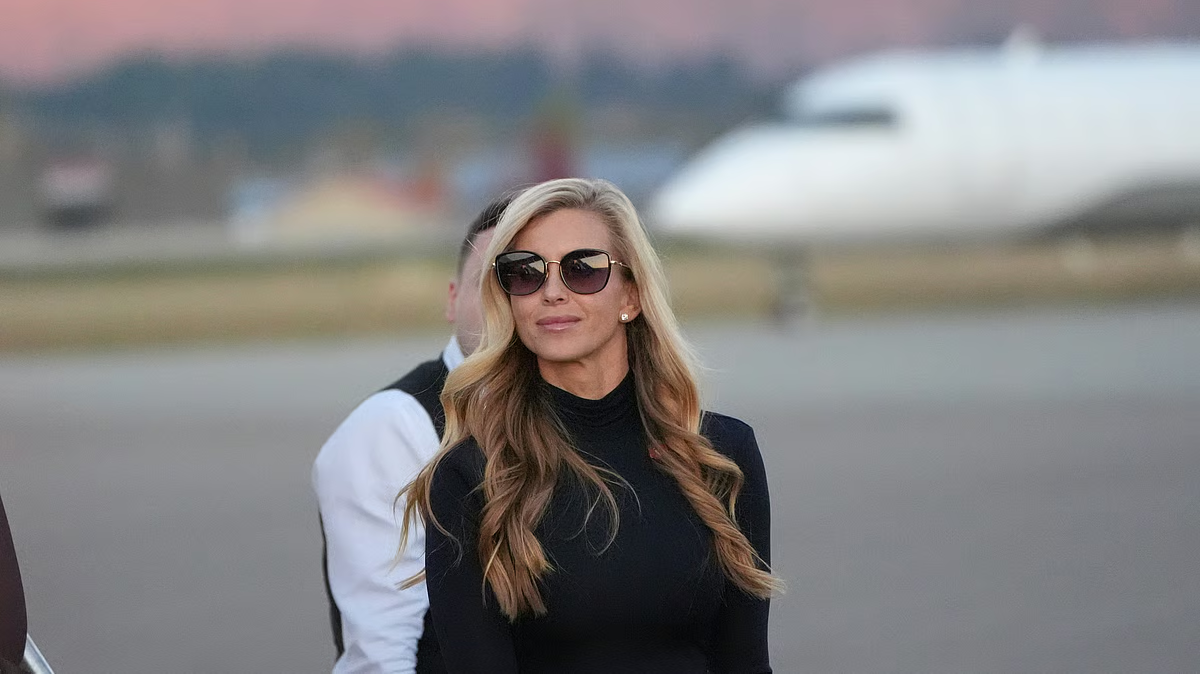
A remark that drew a response from Beijing The comment came less than a week after Zacharia’s appointment as White House press secretary. In the interview, she recalled the perception in 2016 that China was approaching the United States and might soon overtake it. Zacharia said that, after coming from China, she had questioned how the country could be viewed as the next major power when it did not “even have proper toilets.” The supplied reporting establishes the substance of the remark and its setting, but it does not provide the interview’s location or the full exchange surrounding it. The statement was reported by Euronews, The New Indian Express, South China Morning Post and The Hill, which agreed on the central wording and context.
Beijing’s response was delivered publicly rather than through any formal arrangement described in the available reports. Mao Ning, a Chinese spokesperson, said Zacharia was welcome to visit China more often when she had the opportunity. Euronews reported that Mao made the comment at a Friday press briefing and described her as fighting back a smile. The South China Morning Post likewise reported that China had invited Zacharia to visit after the interview. The sources do not specify whether a formal invitation was issued, what a visit would involve, or whether any travel plans were discussed. What is established is a public welcome from Beijing following a disparaging comment about conditions in China.
The interview’s political framing Zacharia made the statement while talking with Jack Posobiec, identified in the supplied sources as a right-wing or conservative commentator. Her discussion centered on a political narrative associated with 2016: that the United States was entering a period in which its “golden days” or “glory days” had ended and China was emerging as the country on the horizon. The remark about toilets was presented as her personal reaction to that perception after she had come from China. The available material does not provide a broader policy argument from Zacharia about China, nor does it establish that the interview was intended as an official statement of United States policy.
Euronews reported that the interview aired on Thursday, followed by Mao Ning’s response at a Friday press briefing. That sequence placed the episode at the beginning of Zacharia’s tenure as the administration’s press secretary. The timing is significant in the limited sense documented by the sources: the comment was made during her first week in the role, and the response from Beijing followed in the next reported briefing. The evidence does not establish any subsequent diplomatic action, a change in United States-China policy, or a decision by Zacharia to accept or decline the welcome. It records a comment, a public reaction and the surrounding early chronology.
A new spokesperson under early scrutiny The toilet remark was not the only issue surrounding Zacharia in the supplied reporting. Euronews reported that she was already under scrutiny over her legal credentials after giving an inconclusive answer about where she had passed the bar exam. The report said she had registered to take the exam but became “distracted and overwhelmed” by plans to move to China with her husband. It also reported that she did not retake the exam after returning to the United States because of the birth of her first child. These details are attributed to Euronews and should not be treated as independently established by the other supplied sources.
Euronews also reported that Zacharia described herself as a lawyer and had listed herself as general counsel of a California-based conservative nonprofit. According to that report, she had previously lived in China and said she had worked at a law firm in Beijing. Those biographical details provide context for why her comments about China attracted attention, but the available evidence does not independently verify her employment history or legal status. The report’s account also does not establish that her time in China informed any official government policy. It shows only that her own background, as described by Euronews, was part of the story surrounding the remarks.
The White House role and the limits of the record The episode unfolded as Zacharia was beginning her public work as press secretary. Euronews reported that she held her first White House press briefing on Tuesday and answered questions from three journalists. The report also said she succeeded Karoline Leavitt, who stepped down in August to care for her young children, and described Leavitt as a loyal Trump supporter and often combative spokesperson. Those details place Zacharia’s appointment within a change in the press operation, but the supplied material does not describe the administration’s reasons for choosing her or set out a formal communications strategy. Nor does it report an official White House response to the China comment.
The sources separately described the broader relationship between the Trump administration and China, but only in limited terms. Euronews reported that President Donald Trump had spoken of his “great relationship” with Chinese President Xi Jinping. It also reported that the two leaders discussed artificial intelligence and trade during a Washington summit in September, along with the stalled war in Iran, and confirmed that they would meet for a third and fourth time that year. These details are part of Euronews’ context for the episode. They do not establish that the press secretary’s comment altered those discussions, affected the leaders’ relationship or represented a position adopted by the administration.