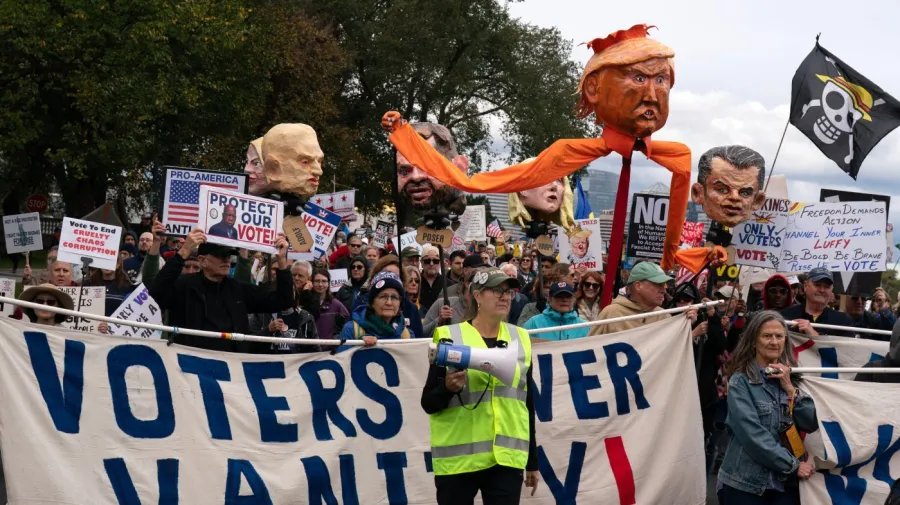
A nationwide protest day with an electoral message
The action brought the No Kings movement’s protest message into the period before the 2026 midterm elections. Reports from The Hill, PBS NewsHour, Al Jazeera, The Japan Times, the South China Morning Post and Deutsche Welle described events taking place across the country on October 17. Their common account was not simply of demonstrations against the president, but of organizers encouraging participants and other Americans to vote early before the November 3 election. That gave the day a dual purpose: expressing opposition to Trump and his administration while directing that opposition toward participation in the electoral process.
The nationwide character of the action did not mean that every location followed the same format. The Japan Times reported that the events included honking convoys, concerts and neighborhood gatherings, rather than only massive marches. That description presents the day as a dispersed mobilization with local variations. The formats allowed the broader No Kings label to cover different kinds of public activity while retaining the same central appeal for early voting. Other reports referred to rallies and protests, but the Japan Times account added detail about how the movement appeared beyond the largest public demonstrations.
A movement extending an existing protest cycle
The October action was presented as part of a longer sequence rather than an isolated event. PBS NewsHour reported that the organizers sought to build on nearly two years of No Kings marches and demonstrations, while Al Jazeera described the events as building on two years of such protests. The difference in wording reflects an approximate chronology, but both accounts place the October 17 action within an established pattern of demonstrations. The reports therefore connect the day’s early-voting message to a movement that had already used marches and demonstrations to organize opposition to Trump’s presidency.
The movement’s political characterization was described in more than one way. PBS NewsHour reported that hundreds of planned events were being billed by some organizers as nonpartisan. At the same time, the same coverage connected the events to people upset with Trump’s presidency, and other reporting described the movement as anti-Trump or as opposing the president and his administration’s policies. Those descriptions are not identical, but they establish the distinction between how some organizers presented the events and how the broader campaign was characterized in coverage. The early-voting appeal was therefore attached to an action that some organizers called nonpartisan while reports also clearly associated it with opposition to Trump.
Estimates show activity, not a single turnout total
The available reporting used different measures to describe the scale of the action. The Hill referred to thousands of No Kings protests, while Al Jazeera reported that thousands gathered at events throughout the country. PBS NewsHour referred to hundreds of planned events. These descriptions concern different aspects of the mobilization—protests, gatherings and planned events—and should not be treated as interchangeable totals. They nevertheless show that coverage portrayed the action as broad and geographically distributed.
The South China Morning Post reported that the movement had organized an estimated 3,000 events and described Sabine Carlson as taking part in one of them near the country’s Capitol. Because the figure was presented as an estimate in that report, it is best understood as a description of the movement’s reported event count rather than as a verified attendance figure. The distinction matters in a nationwide mobilization: the number of sites, the number of protests and the number of people present measure different things. The supplied reporting supports the existence of a large, multi-location action, but the event-count estimate should remain attributed to the South China Morning Post.
Individual participation and the vote message
The South China Morning Post’s account focused on Carlson, whom it described as a 66-year-old Democrat from Washington’s suburbs and a retired teacher. According to that report, she participated in a No Kings demonstration and urged people to vote. Her account, as rendered in the report, placed voting above the expression of anger or the listing of complaints. That emphasis captures the movement’s stated effort to turn a protest audience into an electorate ahead of the midterms, while remaining an attributed account of one participant rather than a measure of the views of everyone at the events.
The focus on early voting also shaped the timing and purpose of the October 17 action. The Hill described the day as a nationwide action during the early-voting period, and PBS NewsHour, Deutsche Welle, The Japan Times and the South China Morning Post all linked the events to efforts to encourage voting before November 3. The reports do not present the demonstrations as a substitute for campaigning or voting; instead, they describe organizers using public events to promote ballot casting. In that sense, the action connected street-level political expression with a specific electoral instruction: vote early in the midterm elections.
What the reporting establishes
Taken together, the sources establish a coordinated No Kings day of action across the United States on October 17, with early voting at the center of the organizers’ message and opposition to Trump forming an important part of the movement’s reported context. They also establish a continuation of demonstrations that had been taking place for nearly two years and a range of event styles, from marches and rallies to convoys, concerts and neighborhood gatherings. The reporting supports describing the action as a nationwide political protest and voter-mobilization campaign, but it does not make every measure of its size equivalent. An estimated number of events, reports of thousands gathered and references to hundreds of planned events describe different dimensions of the day.
The central political question raised by the action was whether opposition expressed through demonstrations would translate into voter participation. The supplied reports document the organizers’ appeal to vote early, but they do not establish an electoral result or show how many participants ultimately cast ballots. What they do show is a movement attempting to move from protest visibility to electoral engagement. On October 17, that effort took place through a broad collection of local events presented as part of one national No Kings action, with its political meaning shaped both by organizers’ nonpartisan description and by extensive reporting on its anti-Trump association.