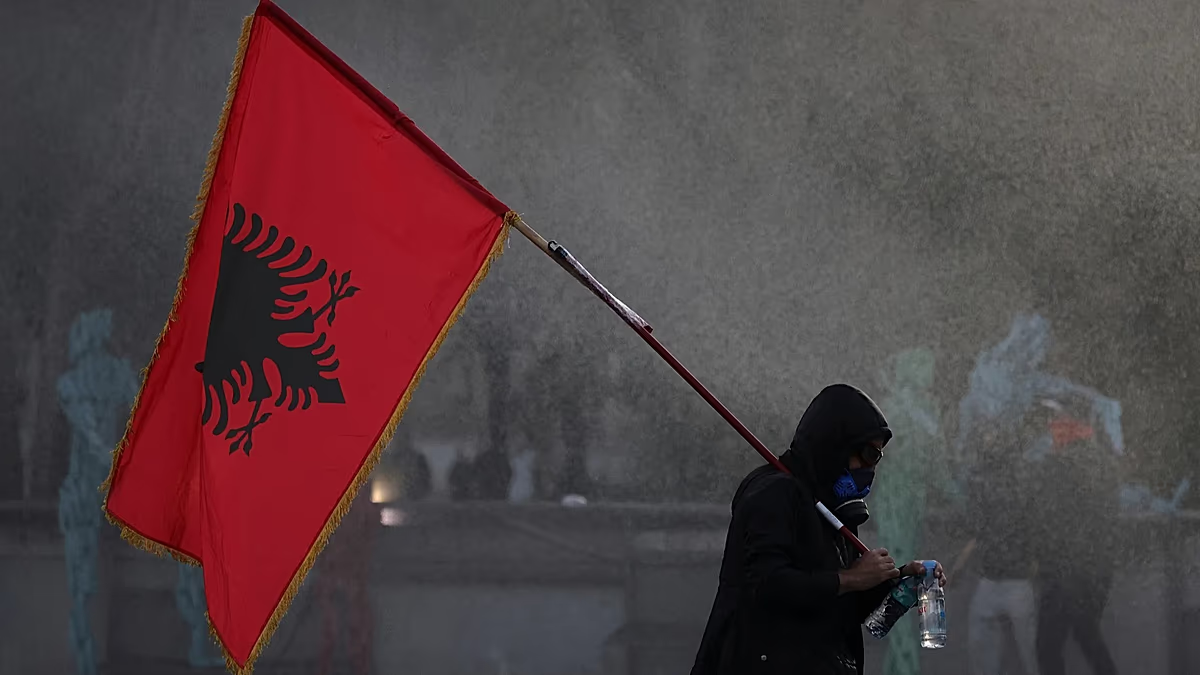
A fourth day of confrontation The demonstrations began on Tuesday and continued for a fourth consecutive day by Friday, according to the supplied reports. In central Tirana, thousands of young protesters marched against Rama’s government, with the prime minister’s resignation among their central demands. The protests combined student-led action with broader anti-government anger, bringing complaints about corruption, education and university conditions into the same streets. France 24 also reported opposition to high tuition fees, while Euronews described demands for education reforms. The result was a movement whose immediate focus was student and youth grievances but whose political message extended directly to the prime minister’s leadership.
The confrontation became violent around the education ministry and elsewhere in the capital. Euronews and Al Jazeera reported that protesters threw stones or other objects, while rubbish bins were set alight and used to block roads. Police responded with tear gas and water cannon as riot officers moved against demonstrators. The supplied reporting also describes damage to windows and traffic lights. These details establish the methods and police response documented in the coverage, but they do not establish that every participant took part in the violence or explain how individual confrontations began.
Rama’s accusation and the EU dispute Rama called for calm while presenting the unrest as something driven from outside the country. In a video address, he said that “foreign hands” did not want Albania to be at peace and rejected the idea that the protests reflected the hardships or legitimate aspirations of people seeking a better life. The reports supplied for this article do not identify whom he meant by that phrase. They also provide no independent evidence establishing foreign involvement. That distinction is central to the episode: Rama’s allegation is documented, but the identity and role of the alleged actors remain unknown.
France 24 reported that Rama said the protests were intended to hinder Albania’s bid to join the European Union. That claim is attributed to France 24 and is not independently corroborated in the supplied material. Al Jazeera’s account presented a related but not identical formulation: Rama said that leaving office would betray Albanians who had given him a mandate to complete negotiations on EU membership. The two accounts place European integration within Rama’s response to the demonstrations, but the available evidence does not establish that the protests were organized to affect the accession process or that foreign actors were directing them.
The EU delegation in Albania also responded to the escalation. Euronews reported that the delegation expressed concern about the violence in Tirana and called on the authorities to respond proportionately. That reaction was reported by Euronews alone in the supplied material. It adds an institutional appeal for restraint to a crisis already framed by Rama in terms of Albania’s European ambitions, but it does not amount to an EU finding about the causes of the protests or the identity of the actors alleged by the prime minister.
Detentions and the spread of unrest Police said that 160 people were detained after violent incidents on Thursday evening, Euronews and Al Jazeera reported. The figure is therefore attributed to a police statement rather than independently verified in the supplied material. The reports do not establish the exact circumstances of each detention, the allegations against those held, or whether the detentions were lawful. That limitation matters when assessing the scale and consequences of the clashes: the number indicates the breadth of the police operation as reported, but it cannot by itself describe the conduct of all demonstrators or determine responsibility for the violence.
Al Jazeera, citing local media, reported that the unrest spread beyond Tirana to Elbasan, Shkodra and Korca. In that account, demonstrators in those cities also broke windows and set fire to rubbish bins. The information about the locations and incidents is attributed to local media through Al Jazeera and is not supported by a second source in the supplied record. What is more firmly established across the reporting is that Tirana remained the centre of the confrontation, with riot police and protesters facing one another during the fourth day of the demonstrations.
A movement with several documented grievances The immediate protests were presented in the supplied coverage as student-led or youth-driven, but the grievances were not limited to one education policy. Al Jazeera described anger over corruption and poor university conditions. Euronews reported calls for education reforms, while France 24 referred to university conditions and high tuition fees. Protesters were also demanding Rama’s resignation, turning a dispute over public services and higher education into a direct challenge to the government. The evidence supports describing these as overlapping demands; it does not support assigning a single cause to every protester or treating the demonstrations as a uniform organization.
The supplied sources also describe a longer arc behind the latest clashes, although they differ in how they frame it. Al Jazeera reported that the protests followed months of mostly peaceful demonstrations, while the reports focused on the latest escalation beginning Tuesday and reaching a fourth day on Friday. Al Jazeera linked the earlier demonstrations to opposition to a luxury resort development associated in its reporting with Jared Kushner, describing the project as a symbol in arguments about alleged corruption and inequality. Because those details come from the supplied source material and concern reported allegations, they should not be treated as independent findings. They do, however, show how the current student protests were placed within a broader account of anti-government mobilization.