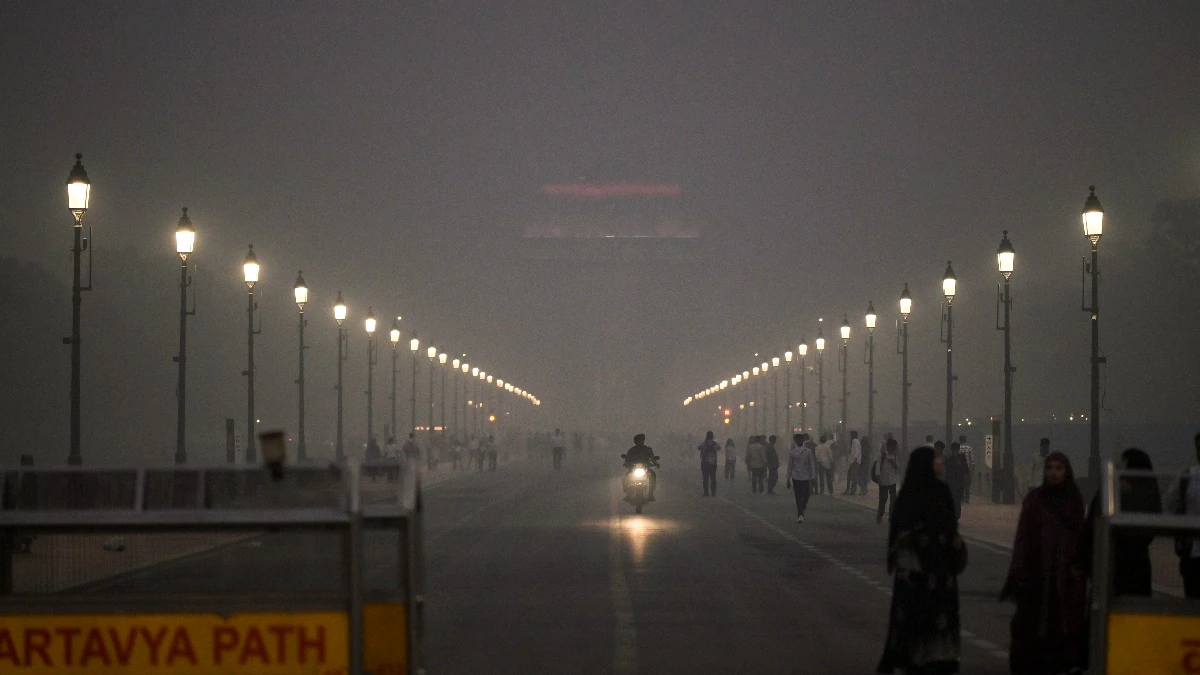
The Hindu reported that Delhi’s 24-hour average Air Quality Index reached 403 at 9 a.m., a reading classified as severe under Central Pollution Control Board data. Other reports cited an AQI of 402 and an overall reading of 494, while some monitoring stations were reported to have exceeded 450. The figures reflect different readings and locations rather than one uniform measurement for the entire city.
The deterioration was also visible on Delhi’s roads, where reports described thick smog or pollution-related haze obscuring the city and reducing visibility. The conditions extended into the wider Delhi-NCR area, with severe pollution reported in Delhi and very poor air quality reported in nearby urban centres in the supplied coverage.
A separate measure offered a different view of the episode’s severity. IQAir data cited by The Hindu placed Delhi’s AQI at 334 and ranked it as the most polluted major city at the time, ahead of Lahore; Al Jazeera also reported that Delhi had overtaken Lahore in the ranking. The Hindu noted that the IQAir and Indian readings use different AQI scales and methodologies, so they should not be treated as directly equivalent.
The sharp deterioration followed a rapid rise in fine-particle pollution. Hindustan Times reported that Delhi’s PM2.5 concentration more than doubled over 24 hours, adding another measure of how quickly conditions worsened. The available reporting establishes the scale of the episode but does not provide one single AQI figure that can represent every location and monitoring system.
The Times of India reported that the Delhi government deployed water sprinklers across the state as part of efforts to control pollution and reduce the impact of particulate matter. The report did not establish that the measure had reversed the deterioration, and the observed reduction in visibility remained a consequence of the pollution episode rather than a response to it.
The episode also prompted political criticism. The Times of India reported that AAP leader Saurabh Bharadwaj criticized the BJP over the post-Diwali rise in pollution and questioned the credibility of CPCB AQI readings. Those allegations remain attributed political claims in the supplied evidence, not independently verified findings. What is established across the reporting is the severe deterioration itself; the precise interpretation of individual readings depends on their time, location and measurement method.
SOURCES
- Times of IndiaDelhi's air quality turns 'hazardous' with AQI at 494
- The HinduDelhi overtakes Lahore as world's most polluted city as air quality drops
- India TodayDelhi air turns severe as AQI hits 402, thick smoke covers city, reduces visibility
- The New Indian ExpressDelhi’s air quality turns hazardous as AQI touches 494
- Hindustan TimesDelhi’s air quality enters ‘severe’ category, AQI breaches 400